Ecuador surpassed China in cases yesterday to become #28. Even though Sweden is #30 now, Bolivia (#32) and the Dominican Republic (#35) are much bigger movers and more likely to be the next to pass China.
Despite the excitement of having reached half a year of coronavirus in Boston, it's been a slow news day. Massachusetts cases are up 0.44% today, due to the ongoing reporting delay issues. Here are the usual maps for the cities and towns data from Wednesday, which came with no warnings about the reporting delay:
(Pop out.)
(Pop out.)
Friday, July 31, 2020


Thursday, July 30, 2020
Day 181: HCQ Again and Again
The world stands at 17.2 million cases. The US at #1 is at 4.5 million, #2 Brazil at 2.5 million, #3 India at 1.6 million. Japan is having a bit of an outbreak (by Asian standards), with at least 1300 new cases today.
In the US, the news is already starting to report Texas taking the #3 spot away from New York (according to the numbers from Johns Hopkins), but at Worldometers, Texas still has a couple of days to go. Because of our blip upwards yesterday due to bad data, Pennsylvania is still about three days away from taking away Massachusetts' #10 spot. Also, GDP shrank a record 33% during the second quarter.
National Geographic reports on the sad demise of a COVID-positive German Shepherd with pre-existing conditions. "Buddy" had shortness of breath before the first American pug case was tested, and may even have been tested privately before the pug. But Buddy's test results were not confirmed by the USDA until June, and he did not pass away until mid-July. National Geographic claims to have consulted vets about Buddy's case, but apparently they didn't like what they heard; they seem quite cagey in giving the obvious explanation—Buddy died of cancer, possibly with COVID (as the conspiracy theorists say), but there's no evidence he was still symptomatic or even positive at the time of his death.
The hydroxychloroquine news just keeps on coming. BNO reported that the Ohio Board of Pharmacy was banning the prescription of HCQ (and chloroquine) for COVID-19. But then the Governor announced he was calling them off, because they're not doctors. (Doctors in the US are normally allowed to prescribe perfectly safe drugs for off-label uses.)
It's unclear how much this Twitter kerfluffle was influenced by the AAPS's motion for a preliminary injunction last week to release the large store of HCQ donated to the US by parties that were not mentioned (but PlagueBlog reminds readers that India is a major donor of HCQ to other countries), or by their supplementary filing.
P.S. Massachusetts cases are up a third of a percentage point today, due in part to the same reporting error from yesterday.
In the US, the news is already starting to report Texas taking the #3 spot away from New York (according to the numbers from Johns Hopkins), but at Worldometers, Texas still has a couple of days to go. Because of our blip upwards yesterday due to bad data, Pennsylvania is still about three days away from taking away Massachusetts' #10 spot. Also, GDP shrank a record 33% during the second quarter.
National Geographic reports on the sad demise of a COVID-positive German Shepherd with pre-existing conditions. "Buddy" had shortness of breath before the first American pug case was tested, and may even have been tested privately before the pug. But Buddy's test results were not confirmed by the USDA until June, and he did not pass away until mid-July. National Geographic claims to have consulted vets about Buddy's case, but apparently they didn't like what they heard; they seem quite cagey in giving the obvious explanation—Buddy died of cancer, possibly with COVID (as the conspiracy theorists say), but there's no evidence he was still symptomatic or even positive at the time of his death.
Medical records provided by the Mahoneys and reviewed for National Geographic by two veterinarians who were not involved in his treatment indicate that Buddy likely had lymphoma, a type of cancer, which would explain the symptoms he suffered just before his death.A rather uninformative partial list of pet and zoo animal cases in the US is available from the USDA.
The hydroxychloroquine news just keeps on coming. BNO reported that the Ohio Board of Pharmacy was banning the prescription of HCQ (and chloroquine) for COVID-19. But then the Governor announced he was calling them off, because they're not doctors. (Doctors in the US are normally allowed to prescribe perfectly safe drugs for off-label uses.)
It's unclear how much this Twitter kerfluffle was influenced by the AAPS's motion for a preliminary injunction last week to release the large store of HCQ donated to the US by parties that were not mentioned (but PlagueBlog reminds readers that India is a major donor of HCQ to other countries), or by their supplementary filing.
P.S. Massachusetts cases are up a third of a percentage point today, due in part to the same reporting error from yesterday.
Wednesday, July 29, 2020
Day 180: The Six-Month Mark
First off, a public service announcement: tonight is the Jewish holiday of Tisha b'Av, commemorating the destruction of the two temples by peaceful protestors the Babylonians and Romans, respectively. Normally the "holiday" involves fasting for 25 hours, but the Ashkenazi Chief Rabbi of Israel has decreed that the COVID-19 positive, anyone who is symptomatic, all recovering patients, and even recovered patients who still feel weak are forbidden from fasting. He also encouraged the use of hand sanitizer and washing, which would normally be highly restricted. (The Sephardic Chief Rabbi only exempts the symptomatic.)
Elsewhere on the Abrahamic religion front, the Hajj has begun. It's not much of a pilgrimage, since no international travel into Saudi Arabia was permitted for the Hajj.
On the HCQ front, India has donated seven tons of hydroxychloroquine to Nigeria to help them fight coronavirus. India itself still recommends HCQ for COVID-19 despite its controversial status in the West (not that we don't still have our share of HCQ proponents.)
Newcomers to PlagueBlog may be confused by our ongoing day count of the coronavirus pandemic. Our first COVID-19 case, a UMass Boston student, flew into Boston from Wuhan on January 28th. He wasn't instantly quarantined for his sniffles; instead he sought medical attention on his own. The news came out on February 1st (Day 1) that he had tested positive for coronavirus, though the CDC had actually reported the positive result to the state on January 31st. Back in the day, we didn't even have a COVID report; he appeared in the MDPH's weekly flu and pneumonia statistics for more than a month before enough positives had joined him to make a webpage out of it.
Since day 1, there has been plenty of coronavirus news to track, and more craziness that anyone ever predicted. From HCQ to 5G towers to mask nazis to starvation and suicide-inducing lockdowns, it's definitely become a situation where not just the cure but pretty much everything is worse than the disease.
The MDPH is celebrating Day 180 by being late with the numbers again, possibly because it's cities and towns day as well.
P.S. Massachusetts cases are up four ninths of a percentage point today, due to a "technical reporting error by a hospital group".
Elsewhere on the Abrahamic religion front, the Hajj has begun. It's not much of a pilgrimage, since no international travel into Saudi Arabia was permitted for the Hajj.
On the HCQ front, India has donated seven tons of hydroxychloroquine to Nigeria to help them fight coronavirus. India itself still recommends HCQ for COVID-19 despite its controversial status in the West (not that we don't still have our share of HCQ proponents.)
Newcomers to PlagueBlog may be confused by our ongoing day count of the coronavirus pandemic. Our first COVID-19 case, a UMass Boston student, flew into Boston from Wuhan on January 28th. He wasn't instantly quarantined for his sniffles; instead he sought medical attention on his own. The news came out on February 1st (Day 1) that he had tested positive for coronavirus, though the CDC had actually reported the positive result to the state on January 31st. Back in the day, we didn't even have a COVID report; he appeared in the MDPH's weekly flu and pneumonia statistics for more than a month before enough positives had joined him to make a webpage out of it.
Since day 1, there has been plenty of coronavirus news to track, and more craziness that anyone ever predicted. From HCQ to 5G towers to mask nazis to starvation and suicide-inducing lockdowns, it's definitely become a situation where not just the cure but pretty much everything is worse than the disease.
The MDPH is celebrating Day 180 by being late with the numbers again, possibly because it's cities and towns day as well.
P.S. Massachusetts cases are up four ninths of a percentage point today, due to a "technical reporting error by a hospital group".
Tuesday, July 28, 2020
Day 179: Hydroxychloroquine on Repeat
In world news, Kazakhstan has crossed the China line, despite China's growing outbreak in Xinjiang. Next up is the Philippines.
In the US, Florida has joined California in besting New York in coronavirus cases, pushing the erstwhile #1 state down to an embarrassing #3. Texas is going to take a bit longer to join the club. North Carolina has made the jump to 9th place, knocking Massachusetts down to #10. Next up is Pennsylvania, which seems to be having enough of a revival to top us in a couple of days, as our cases are up only a fifth of a percentage point today (not to gloat).
Pennsylvania is taking this opportunity todestroy its restaurant industry re-limit restaurant seating capacity to 25%, which is predicted to lead to the closure of 7,500 restaurants. On the wider economic front, the NFL has cancelled its pre-season, and Forbes predicts a dim economic future for colleges.
The United Nations estimates that 10,000 children are dying of coronavirus-related malnutrition per month. (That's approximately 10,000 more children than are dying of COVID-19 itself.) The Director of the CDC notes that children and teens are at "far greater" risk of death from suicide, overdoses, and the flu than from COVID-19. He thinks sending them back to school is the only solution.
On the hydroxychloroquine (HCQ) front, PlagueBlog found this paranoid analysis of its star-crossed history as a coronavirus treatment to be an entertaining timeline of events. This site maintains a timeline of scientific papers about HCQ, with the results for humans (or lack of such) nicely summarized.
In the US, Florida has joined California in besting New York in coronavirus cases, pushing the erstwhile #1 state down to an embarrassing #3. Texas is going to take a bit longer to join the club. North Carolina has made the jump to 9th place, knocking Massachusetts down to #10. Next up is Pennsylvania, which seems to be having enough of a revival to top us in a couple of days, as our cases are up only a fifth of a percentage point today (not to gloat).
Pennsylvania is taking this opportunity to
The United Nations estimates that 10,000 children are dying of coronavirus-related malnutrition per month. (That's approximately 10,000 more children than are dying of COVID-19 itself.) The Director of the CDC notes that children and teens are at "far greater" risk of death from suicide, overdoses, and the flu than from COVID-19. He thinks sending them back to school is the only solution.
On the hydroxychloroquine (HCQ) front, PlagueBlog found this paranoid analysis of its star-crossed history as a coronavirus treatment to be an entertaining timeline of events. This site maintains a timeline of scientific papers about HCQ, with the results for humans (or lack of such) nicely summarized.
Monday, July 27, 2020
Day 178: Still Not the Kids
It's hardly been a week since the New York Times ("all the news that's unfit to print") misinterpreted a Korean study to blame older children for transmitting coronavirus, even though the lack of transmission and illness in children is one of the most obvious and unusual qualities of the new SARS. Not one but two studies are out in preprint showing that children actually impede transmission.
Dyke wardens or Drivers? Why children may play an attenuating role in the spread of SARS-CoV-2 came out in mid-July. The authors note the low likelihood of asymptomatic spread, as well as children's higher likelihood of being uninfected or asymptomatic, and that at the seven-month point in the pandemic, we know kids just don't get infected; they weren't just escaping exposure temporarily. Even teens are less likely to ever show symptoms than adults.
When children and young adults do show symptoms, their symptoms are milder and briefer than in adults, which makes the children that much less likely to spread the disease, and, perhaps more importantly, likely to spread it at lower doses, resulting in milder cases for those they do infect. Children also seem less likely to catch the virus in the first place. Their immune systems are better, or perhaps just busier with the many other viruses they're constantly spreading around.
It's not an experimental report, but the authors do note plenty of circumstantial evidence for their theory. Most notably, SARS and MERS were also unlikely to cause symptoms in or to be spread by children. At the country level, more youth-filled countries have experienced milder pandemics than elsewhere. They admit that school closures may have impeded the spread, though they find little proof in the literature for the efficacy of locking down the children.
The other preprint, On the effect of age on the transmission of SARS-CoV-2 in households, schools and the community, came out Friday. The authors dig an overwhelming number of transmission rate estimates and seroprevalences out of the literature. Although many of the studies also found low transmission rates among teens, their final conclusion is that the under-10 set are at most half as susceptible as adults, but pre-teens and teens should be treated with caution along with all adults under 35, because of their similarities to that group's high spreading potential.
P.S. Massachusetts cases are up a quarter of a percentage point today.
Dyke wardens or Drivers? Why children may play an attenuating role in the spread of SARS-CoV-2 came out in mid-July. The authors note the low likelihood of asymptomatic spread, as well as children's higher likelihood of being uninfected or asymptomatic, and that at the seven-month point in the pandemic, we know kids just don't get infected; they weren't just escaping exposure temporarily. Even teens are less likely to ever show symptoms than adults.
When children and young adults do show symptoms, their symptoms are milder and briefer than in adults, which makes the children that much less likely to spread the disease, and, perhaps more importantly, likely to spread it at lower doses, resulting in milder cases for those they do infect. Children also seem less likely to catch the virus in the first place. Their immune systems are better, or perhaps just busier with the many other viruses they're constantly spreading around.
It's not an experimental report, but the authors do note plenty of circumstantial evidence for their theory. Most notably, SARS and MERS were also unlikely to cause symptoms in or to be spread by children. At the country level, more youth-filled countries have experienced milder pandemics than elsewhere. They admit that school closures may have impeded the spread, though they find little proof in the literature for the efficacy of locking down the children.
The other preprint, On the effect of age on the transmission of SARS-CoV-2 in households, schools and the community, came out Friday. The authors dig an overwhelming number of transmission rate estimates and seroprevalences out of the literature. Although many of the studies also found low transmission rates among teens, their final conclusion is that the under-10 set are at most half as susceptible as adults, but pre-teens and teens should be treated with caution along with all adults under 35, because of their similarities to that group's high spreading potential.
P.S. Massachusetts cases are up a quarter of a percentage point today.
Sunday, July 26, 2020
Day 177: Finally the Flu
It must be a slow news day, because a lot of "record" numbers were reported today. Though the world is at a far-from-round 16.4 million cases, Worldometer has declared a cool 10 million persons recovered. Earlier today, when the death toll surpassed 650,000, BNO News noted that we have finally, after more than seven months, exceeded the estimated death count of a severe (though not pandemic) flu year (646,000).
India (#3) had a record of over 50,000 cases today. NPR reports a bit of a flare-up in #9 Spain which "could already be a second wave."
As expected, California took first place in total cases yesterday. In a less-watched number, Louisiana has exceeded New York to take first place in cases per capita. And on the adding-insult-to-injury front, the city of Los Angeles has, without warning, fined a bunch of already-suffering local businesses $356 apiece for hanging up banners saying they're open.
Paul Graham has posted a few times now about what we here in the PlagueBlog newsroom refer to as "the new crazy". His first couple of posts were brief; the first one noted the hubris of some not particularly qualified folks making not particularly reliable predictions back in April about the impact of coronavirus:
Massachusetts cases are up a third of a percentage point today. This may reflect a tiny upward trend.
India (#3) had a record of over 50,000 cases today. NPR reports a bit of a flare-up in #9 Spain which "could already be a second wave."
As expected, California took first place in total cases yesterday. In a less-watched number, Louisiana has exceeded New York to take first place in cases per capita. And on the adding-insult-to-injury front, the city of Los Angeles has, without warning, fined a bunch of already-suffering local businesses $356 apiece for hanging up banners saying they're open.
Paul Graham has posted a few times now about what we here in the PlagueBlog newsroom refer to as "the new crazy". His first couple of posts were brief; the first one noted the hubris of some not particularly qualified folks making not particularly reliable predictions back in April about the impact of coronavirus:
But epidemics are rare enough that these people clearly didn't realize [rapid falsification of their predictions] was even a possibility. Instead they just continued to use their ordinary m.o., which, as the epidemic has made clear, is to talk confidently about things they don't understand.The second one was directed at cancel culture, but correct coronavirus thought is a more pressing example of orthodox privilege:
The more conventional-minded someone is, the more it seems to them that it's safe for everyone to express their opinions.The third one, on conformism, is longer and more interesting. He concludes with the tragedy of the conformists taking over the universities—institutions formerly devoted to non-conformist thought. (He has implied in the past that there is no such thing as conformist thought; it is a contradiction in terms.)
Enforcers of orthodoxy can't allow a borderline idea to exist, because that gives other enforcers an opportunity to one-up them in the moral purity department, and perhaps even to turn enforcer upon them. So instead of getting the margin for error we need, we get the opposite: a race to the bottom in which any idea that seems at all bannable ends up being banned.In terms of coronavirus, it is conformism in science that is the contradiction in terms. If you are preaching the absolute truth of some result from a paper or papers you haven't even read (never mind having read the other papers that contradicted it), you are a conformist. You are not part of the solution; you're part of the minefield.
[...]
Having ideas in a world where some ideas are banned is like playing soccer on a pitch that has a minefield in one corner. You don't just play the same game you would have, but on a different shaped pitch. You play a much more subdued game even on the ground that's safe.
Massachusetts cases are up a third of a percentage point today. This may reflect a tiny upward trend.
Saturday, July 25, 2020
Day 176: Overreaction
The world is now well past 16 million cases. In a surprise move, Kazakhstan shot past both Ecuador and Sweden to take the #27 spot after China. In another surprise move, Kim Jong-un overreacted over an allegedly-infected escapee returning from South Korea by declaring a state of emergency and locking down Kaesong.
With a rare measure of paranoia for Brazil, Rio de Janeiro has already cancelled2021 their traditional New Year's celebrations. They've not yet cancelled Carnaval, but São Paulo has "indefinitely postponed" it.
A story out of Portugal about an asymptomatic mother who miscarried at 8 months has spooked the innumerate, only partly because they can't read the rest of the article. It goes to some effort to say how rare any sort of transmission to the fetus or symptoms in pregnant mothers have been, not only in Portugal but worldwide. There are plenty of rumors of an increase in stillbirths during the pandemic, but little science to back them up—at least, not qua coronavirus deaths.
Where an uptick has been found, e.g., in London, it's not at all clear that the deaths have anything to do with cryptic COVID-19 infection—especially in that study, where the mothers were all non-positive and the placentas were examined for signs of infection without result. The alternative explanation seems far more likely, especially in Britain where pregnancies aren't as heavily monitored as in the US to begin with:
With a rare measure of paranoia for Brazil, Rio de Janeiro has already cancelled
A story out of Portugal about an asymptomatic mother who miscarried at 8 months has spooked the innumerate, only partly because they can't read the rest of the article. It goes to some effort to say how rare any sort of transmission to the fetus or symptoms in pregnant mothers have been, not only in Portugal but worldwide. There are plenty of rumors of an increase in stillbirths during the pandemic, but little science to back them up—at least, not qua coronavirus deaths.
Where an uptick has been found, e.g., in London, it's not at all clear that the deaths have anything to do with cryptic COVID-19 infection—especially in that study, where the mothers were all non-positive and the placentas were examined for signs of infection without result. The alternative explanation seems far more likely, especially in Britain where pregnancies aren't as heavily monitored as in the US to begin with:
Alternatively, the increase in stillbirths may have resulted from indirect effects such as reluctance to attend hospital when needed (eg, with reduced fetal movements), fear of contracting infection, or not wanting to add to the National Health Service burden. Changes in obstetric services may have played a role secondary to staff shortages or reduced antenatal visits, ultrasound scans, and/or screening.Massachusetts cases are up a quarter of a percentage point today.
Friday, July 24, 2020
Day 175: Kissing the Comity Clause Goodbye
The world is on the cusp of 16 million coronavirus cases. Ecuador snuck past Sweden today to take the #27 slot just below China. The Guardian reports that Australia's success story has "unravelled". Here at PlagueBlog we don't count their #73 spot as a notable failure, nor are we impressed with case counts on the order of the post-surge UK. But perhaps this will disabuse them of the notion of locking down the flu a contagious respiratory disease.
Here in Massachusetts, our numbers (after a three and a half hour reporting delay) are up 0.3% again today. Maybe the MDPH is busy patrolling the borders, now that the governor has bureaucratized our fluctuating 14-day quarantine for travelers with new regulations. The only significant change is the new paperwork for people from the 42 germy states, and the movement of Hawaii from the germy category to thesafe low-risk category. (There's a map.)
Connecticut also has a form and a map, though their map includes many more states. Rhode Island just has a google doc. New Hampshire only permits New Englanders to visit without quarantine, while Maine has a short, random list that specifically disses Massachusetts. Vermont breaks things down by county in the rather perverse belief that they're attracting tourists from woodsy places that are just as boring and underpopulated as Vermont itself.
PlagueBlog notes that Article IV, Section 2, Clause 2 of the U.S. Constitution (also known as the Comity Clause or the Privileges and Immunities Clause) states that "The Citizens of each State shall be entitled to all Privileges and Immunities of Citizens in the several States." Nowhere does it restrict those privileges and immunities to germ-free states.
Here in Massachusetts, our numbers (after a three and a half hour reporting delay) are up 0.3% again today. Maybe the MDPH is busy patrolling the borders, now that the governor has bureaucratized our fluctuating 14-day quarantine for travelers with new regulations. The only significant change is the new paperwork for people from the 42 germy states, and the movement of Hawaii from the germy category to the
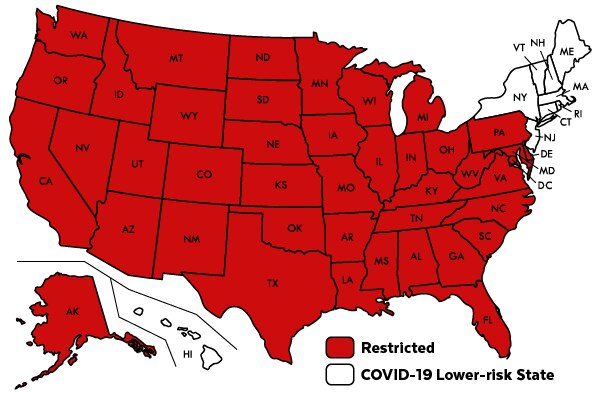
Connecticut also has a form and a map, though their map includes many more states. Rhode Island just has a google doc. New Hampshire only permits New Englanders to visit without quarantine, while Maine has a short, random list that specifically disses Massachusetts. Vermont breaks things down by county in the rather perverse belief that they're attracting tourists from woodsy places that are just as boring and underpopulated as Vermont itself.
PlagueBlog notes that Article IV, Section 2, Clause 2 of the U.S. Constitution (also known as the Comity Clause or the Privileges and Immunities Clause) states that "The Citizens of each State shall be entitled to all Privileges and Immunities of Citizens in the several States." Nowhere does it restrict those privileges and immunities to germ-free states.
Thursday, July 23, 2020
Day 174: Just Say No To Lockdowns
South Africa has exceeded 400,000 cases; it is now more than halfway to #4 Russia. Peru (#6) and #7 Mexico are also climbing steadily towards 400,000, and #15 Colombia and #20 Argentina are racking up more than 5,000 cases a day.
In the US, California is not quite #1 yet, but they're looking like a shoe-in for tomorrow. Louisiana at #12 has just broken the 100,000 case mark, and has joined the queue of states waiting to dethrone #9 Massachusetts. For unknown reasons, the MDPH has not published our case numbers for today yet (an unprecedented 5 hours after the usual time).
A paper in EClinicalMedicine evaluating policies and socio-economics in 50 countries concludes that lockdowns don't help, smoking does help, GDP is bad for you, and obesity definitely hurts. Despite not helping with mortality, lockdowns did improve recovery rates, which the authors speculate had to do with flattening the curve (as the kids say). They write off the GDP correlation as possibly testing-related, or too much disposable income for vacationing in COVID hotspots like ski resorts.
The authors are also mystified by the smoking data, wave their hands a bit about average age in smokier countries, and think more study is necessary, when plenty has been done already. That they can't read the literature doesn't necessarily mean they can't do the math (multivariable negative binomial regression), though the 50 countries with the most cases as of May 1st is not the most promising data set, all their statistical precautions aside. Still, it's encouraging that they reproduced a well-known pro-smoking result despite not knowing about it.
On the mapping front, now that there are two weeks of the new data we can restore the case rate map. These case rates will be a bit different from the previous ones provided by the MDPH, based on their super-secret population numbers; the new map is based entirely on US Census numbers for our cities and towns (rather than only partially in those cases where the state was not previously reporting its own rate).
(Pop out.)
On the down side, the testing rate map is lost and gone forever, because the MDPH no longer reports test rates on a per-person basis, but on a per-test basis. While perhaps still informative about testing policy, the new data is no longer particularly relevant to coronavirus, so has not been mapped.
P.S. Massachusetts cases are up 0.3% percent today.
In the US, California is not quite #1 yet, but they're looking like a shoe-in for tomorrow. Louisiana at #12 has just broken the 100,000 case mark, and has joined the queue of states waiting to dethrone #9 Massachusetts. For unknown reasons, the MDPH has not published our case numbers for today yet (an unprecedented 5 hours after the usual time).
A paper in EClinicalMedicine evaluating policies and socio-economics in 50 countries concludes that lockdowns don't help, smoking does help, GDP is bad for you, and obesity definitely hurts. Despite not helping with mortality, lockdowns did improve recovery rates, which the authors speculate had to do with flattening the curve (as the kids say). They write off the GDP correlation as possibly testing-related, or too much disposable income for vacationing in COVID hotspots like ski resorts.
The authors are also mystified by the smoking data, wave their hands a bit about average age in smokier countries, and think more study is necessary, when plenty has been done already. That they can't read the literature doesn't necessarily mean they can't do the math (multivariable negative binomial regression), though the 50 countries with the most cases as of May 1st is not the most promising data set, all their statistical precautions aside. Still, it's encouraging that they reproduced a well-known pro-smoking result despite not knowing about it.
On the mapping front, now that there are two weeks of the new data we can restore the case rate map. These case rates will be a bit different from the previous ones provided by the MDPH, based on their super-secret population numbers; the new map is based entirely on US Census numbers for our cities and towns (rather than only partially in those cases where the state was not previously reporting its own rate).
(Pop out.)
On the down side, the testing rate map is lost and gone forever, because the MDPH no longer reports test rates on a per-person basis, but on a per-test basis. While perhaps still informative about testing policy, the new data is no longer particularly relevant to coronavirus, so has not been mapped.
P.S. Massachusetts cases are up 0.3% percent today.
Wednesday, July 22, 2020
Day 173: NO Means Nitric Oxide
The most notable development on the international front is Bolsonaro's third positive coronavirus test, taken yesterday and reported today.
California is still a day or two away from New York's #1 spot, though nothing can ever take away Governor Cuomo's title of Most Likely To Kill Your Grandma. In fact, California remains remarkably inefficient at killing people, with only 200 deaths per million, and will probably never achieve New York's high of 1,676 deaths per million. (The US average is about 440.) Of course the New York Times pats itself and the rest of the Northeast on the back forhaving already killed our low-hanging fruit our amazing pandemic control. Yelp, of all places, is unimpressed by the grandma slaughter's lockdown's effects on the economy, though; they report 132,500 business closures at the moment, 55% of them permanent.
On the science front, a future article in the official journal of the International Nitric Oxide Society already available online posits (you guessed it) nitric oxide (NO) as a prophylactic against COVID-19. While the paper references some previous in vitro and inhalation experiments with NO against the previous SARS epidemic, they go into far more reviewing detail about the efficacy of smoking as a COVID prophylactic, and why NO might be the reason. PlagueBlog readers may recall that nicotine has also been proposed as the smokers' secret weapon, and the authors also mention carbon dioxide as a potential mechanism, though their hearts are clearly in the NO theory.
Also on the science front is an interesting preprint out of Ireland, in which the region reporting experienced a significant drop (73%) in premature births (with no corresponding increase in stillbirths). The authors enumerate quite a few potential factors brought on by the lockdown, most of which were already known to be associated with premature birth, but have no specific data on those points. If PlagueBlog had to guess, we would go with the reduction in maternal work stress and physical workload as the most pervasively changed by the pandemic, rather than with more external, seasonal, and variable factors like air pollution, exposure to infection, and partner support.
Massachusetts cases are up a quarter of a percentage point again today. The cities and towns report is out; here's the data, set up the same as last week. (The PlagueBlogpunch-card girls computers may grind out a few more details tomorrow.)
(Pop out.)
California is still a day or two away from New York's #1 spot, though nothing can ever take away Governor Cuomo's title of Most Likely To Kill Your Grandma. In fact, California remains remarkably inefficient at killing people, with only 200 deaths per million, and will probably never achieve New York's high of 1,676 deaths per million. (The US average is about 440.) Of course the New York Times pats itself and the rest of the Northeast on the back for
On the science front, a future article in the official journal of the International Nitric Oxide Society already available online posits (you guessed it) nitric oxide (NO) as a prophylactic against COVID-19. While the paper references some previous in vitro and inhalation experiments with NO against the previous SARS epidemic, they go into far more reviewing detail about the efficacy of smoking as a COVID prophylactic, and why NO might be the reason. PlagueBlog readers may recall that nicotine has also been proposed as the smokers' secret weapon, and the authors also mention carbon dioxide as a potential mechanism, though their hearts are clearly in the NO theory.
We hypothesize, in view of our knowledge of NO and positive experience with NO inhalation in the SARS epidemic, that the intermittent bursts of high NO concentration in cigarette smoke may be a likely mechanism in protecting against the virus. To copy the intermittent high NO concentration by breathing in NO from a gas tank is problematic, since NO2 will build up during dilution with air to potentially toxic concentrations. Pulsed short bursts of high NO concentration will require a delivery system for inhaled NO that is independent on supply from a gas tank. Such a tankless system does exist, and has been approved by the US FDA.In a rare moment of honesty for the scientific literature (which may have something to do with the majority of the paper's authors hailing from Sweden), the authors address the ongoing misinterpretation of the clear evidence in favor of smoking:
The reluctance may be due to a general opposition to smoking and fear of using tobacco to prevent the ongoing pandemic.As the panicked masses would put it, smoking is better than dying.
Also on the science front is an interesting preprint out of Ireland, in which the region reporting experienced a significant drop (73%) in premature births (with no corresponding increase in stillbirths). The authors enumerate quite a few potential factors brought on by the lockdown, most of which were already known to be associated with premature birth, but have no specific data on those points. If PlagueBlog had to guess, we would go with the reduction in maternal work stress and physical workload as the most pervasively changed by the pandemic, rather than with more external, seasonal, and variable factors like air pollution, exposure to infection, and partner support.
Massachusetts cases are up a quarter of a percentage point again today. The cities and towns report is out; here's the data, set up the same as last week. (The PlagueBlog
(Pop out.)
Tuesday, July 21, 2020
Day 172: Red Tape and Turf Battles
The world's case count has reached 15 million; the US is at 4 million. California has made the news by hitting 400,000 cases, making it a real contender to take the #1 spot away from New York. Florida isn't far behind at 369,000 cases. Massachusetts is up a fifth of a percentage point again today, not to gloat.
The coronavirus news is mostly on repeat. The New York Times documents "red tape and turf battles" over temporary hospitals in New York City. But like previous reports of other coronavirus boondoggles, this one is high on anecdotes of failure and low on explanations for it. Not unlike the pandemic in general, it reads like an Ayn Rand novel sans the plot.
Bloomberg opines that even college students belong back in school. A seroprevalence study in Delhi found a lot of prevalence. There's yet another preprint out about the protection provided by childhood BCG vaccination, though this one is titled in the form of a question: "Do low TB prevalence or lack of BCG Vaccination Contribute to Emergence [sic] Multisystem Inflammatory Syndrome?"
A paper in Annals of the Rheumatic Diseases has once again shown steroids useful; in fact it showed glucocorticoids extremely useful, but the randomization was a bit hacked up after the fact using historical data, and much of the improved outcome seemed to result from the steroid patients not being put on ventilators. Because of the time lag between the control group and the experimental group, there is no real guarantee that the same standard of care was used to decide on mechanical ventilation. (Also, a relatively small effect from the steroids would have an outsized positive outcome, if it was enough to prevent mechanical ventilation.) The authors were unwilling to do a truly randomized trial of their miracle cure at the time, and even question the medical ethics of doing one without the pandemic pressures they were under. So don't hold your breath for the truly randomized trial results.
The coronavirus news is mostly on repeat. The New York Times documents "red tape and turf battles" over temporary hospitals in New York City. But like previous reports of other coronavirus boondoggles, this one is high on anecdotes of failure and low on explanations for it. Not unlike the pandemic in general, it reads like an Ayn Rand novel sans the plot.
Bloomberg opines that even college students belong back in school. A seroprevalence study in Delhi found a lot of prevalence. There's yet another preprint out about the protection provided by childhood BCG vaccination, though this one is titled in the form of a question: "Do low TB prevalence or lack of BCG Vaccination Contribute to Emergence [sic] Multisystem Inflammatory Syndrome?"
A paper in Annals of the Rheumatic Diseases has once again shown steroids useful; in fact it showed glucocorticoids extremely useful, but the randomization was a bit hacked up after the fact using historical data, and much of the improved outcome seemed to result from the steroid patients not being put on ventilators. Because of the time lag between the control group and the experimental group, there is no real guarantee that the same standard of care was used to decide on mechanical ventilation. (Also, a relatively small effect from the steroids would have an outsized positive outcome, if it was enough to prevent mechanical ventilation.) The authors were unwilling to do a truly randomized trial of their miracle cure at the time, and even question the medical ethics of doing one without the pandemic pressures they were under. So don't hold your breath for the truly randomized trial results.
Monday, July 20, 2020
Day 171: Moral Panic
A week ago, South Africa was at #10 in coronavirus cases, but over the past week it shot up through the ranks to its current #5 position (displacing Peru). At 373,000 cases, it still has fewer than half of what it needs to displace #4 Russia, but, despite the low rankings of other African nations, the WHO sees ominous signs in South Africa for the rest of the continent.
The US is approaching 4 million cases, almost 2 million of them resolved. Massachusetts cases are up a fifth of a percentage point today, not to gloat. Both Pennsylvania and North Carolina are making slow progress in their quest for our #9 slot.
The federal government's internal struggle over COVID-19 case data gets some elucidation in Politico, and a new coronavirus data website, HHS Protect, is born. Because we didn't have enough of them already...
Also in the US, the moral panic prompted by this spring's sudden and unexpected discovery that people occasionally die of communicable diseases rages on. The New York Times maps masks across the US and reveals that Americans are more masked than the Taiwanese, not to mention Canadians, Brits, and Australians. And yet the demon anti-maskers still receive the lion's share of the blame for our coronavirus deaths.
While the forces of "science" may be resting on their mask-mandating laurels, the debate over reopening the schools rages on. The Economist joins the growing pro-school ranks with an article on the dangers of keeping schools closed. On the other hand, the Florida branch of the American Academy of Pediatrics bucks the parent organization's pro-school stance with their anti-school letter to the governor. Likewise, Reuters reports that the Florida teachers union has sued to stop schools from opening in August.
On the science front, there are more cases of reinfection popping up, one in South Africa and at least one in Israel, both after three months. Renewed symptoms were not noted in the reports. The CDC still hasn't found evidence of actual reinfection and presumes that any positive tests during the first 90 days after infection are detecting remnants of the original viral particles, though they might sit up and take notice for actual symptoms. (The 3-month standard was adopted from another beta coronavirus for which immunity lasts only 90 days.)
A preliminary, positive report is out on the ChAdOx1 vaccine:
The US is approaching 4 million cases, almost 2 million of them resolved. Massachusetts cases are up a fifth of a percentage point today, not to gloat. Both Pennsylvania and North Carolina are making slow progress in their quest for our #9 slot.
The federal government's internal struggle over COVID-19 case data gets some elucidation in Politico, and a new coronavirus data website, HHS Protect, is born. Because we didn't have enough of them already...
Also in the US, the moral panic prompted by this spring's sudden and unexpected discovery that people occasionally die of communicable diseases rages on. The New York Times maps masks across the US and reveals that Americans are more masked than the Taiwanese, not to mention Canadians, Brits, and Australians. And yet the demon anti-maskers still receive the lion's share of the blame for our coronavirus deaths.
While the forces of "science" may be resting on their mask-mandating laurels, the debate over reopening the schools rages on. The Economist joins the growing pro-school ranks with an article on the dangers of keeping schools closed. On the other hand, the Florida branch of the American Academy of Pediatrics bucks the parent organization's pro-school stance with their anti-school letter to the governor. Likewise, Reuters reports that the Florida teachers union has sued to stop schools from opening in August.
On the science front, there are more cases of reinfection popping up, one in South Africa and at least one in Israel, both after three months. Renewed symptoms were not noted in the reports. The CDC still hasn't found evidence of actual reinfection and presumes that any positive tests during the first 90 days after infection are detecting remnants of the original viral particles, though they might sit up and take notice for actual symptoms. (The 3-month standard was adopted from another beta coronavirus for which immunity lasts only 90 days.)
A preliminary, positive report is out on the ChAdOx1 vaccine:
ChAdOx1 nCoV-19 showed an acceptable safety profile, and homologous boosting increased antibody responses. These results, together with the induction of both humoral and cellular immune responses, support large-scale evaluation of this candidate vaccine in an ongoing phase 3 programme.
Sunday, July 19, 2020
Day 170: In a cavern, in a canyon, excavating for a mine...
Deaths worldwide have topped 600,000. In the US, Florida is now well in the lead of Texas and is eyeing California's #2 spot. Massachusetts cases are up a quarter of a percentage point today.
The mainstream news of the day seems to be the New York Times' sketchy take on a study out of South Korea, in which the Korean scientists were careful to state that they did not determine the direction of transmission, or even that transmission was familial at all. Nevertheless, the Times jumps to the conclusion that children aged 10 and up can transmit the disease as well as adults. Just one of those coronavirus "facts" you'll probably need to conveniently forget later...
The interesting news of the day, however, is a commentary in Independent Science News on the lab origin theory of the current pandemic. PlagueBlog readers may recall previous made-in-a-lab theories involving the mysterious coronavirus sequence known as RaTG13, and Dr. Shi of the suspiciously-located Wuhan Institute of Virology. This theory differs on a few points. It accepts RaTG13 as a genuine, natural coronavirus, spends a good deal of time debunking the opposition (an oft-cited review in Nature from March), and tells a new story about COVID-"19" in which it is actually COVID-12:
The flurry of virus-hunting behavior in the mine by Dr. Shi and others after the miners fell ill is thus deeply suspicious, as is their publication of RaTG13 and a prior subsequence without any comment on the miners or their disease, instead asserting that the distant Yunnan province mine where they collected their samples was "abandoned".
To account for the differences between RaTG13 and its closest coronaviral relative, SARS-CoV-2, the authors propose viral evolution within the six miners as their "Mojiang Miners Passage (MMP) hypothesis". Specifically, the virus evolved in their lungs, an unusual locus of coronavirus infection (at the time) that they believe was particularly conducive to the recombination of RaTG13 and other coronaviruses from the mine into SARS-CoV-2.
They also posit an explanation for the long delay between COVID-12 and COVID-19:
PlagueBlog notes there is something off about the notion that six miners breathing bat guano could substitute for the missing human evolution phase of SARS-CoV-2 that has made it so stable since. It is particularly mysterious how all six of them fell so ill at the same time, and yet the mine has failed to start the number of pandemics this rate of attack would seem to promise. Bats are not known for flying about in tiny masks, so perhaps the mine workers themselves did something unusually unsanitary. They were allegedly cleaning out bat guano at the time they fell ill, which doesn't seem like the most productive or typical miner employment.
PlagueBlog recommends that, when you see a bat, you run screaming in the other direction. (A mask should not be worn for this purpose, as it impedes proper screaming.) In particular, do not gather or eat its guano for any reason whatsoever.
The mainstream news of the day seems to be the New York Times' sketchy take on a study out of South Korea, in which the Korean scientists were careful to state that they did not determine the direction of transmission, or even that transmission was familial at all. Nevertheless, the Times jumps to the conclusion that children aged 10 and up can transmit the disease as well as adults. Just one of those coronavirus "facts" you'll probably need to conveniently forget later...
The interesting news of the day, however, is a commentary in Independent Science News on the lab origin theory of the current pandemic. PlagueBlog readers may recall previous made-in-a-lab theories involving the mysterious coronavirus sequence known as RaTG13, and Dr. Shi of the suspiciously-located Wuhan Institute of Virology. This theory differs on a few points. It accepts RaTG13 as a genuine, natural coronavirus, spends a good deal of time debunking the opposition (an oft-cited review in Nature from March), and tells a new story about COVID-"19" in which it is actually COVID-12:
The story begins in April 2012 when six workers in that same Mojiang mine fell ill from a mystery illness while removing bat faeces. Three of the six subsequently died.The authors had the thesis translated, from which it became clear the miners suffered from a disease very similar to COVID-19, and not from fungal infection. In fact their doctors consulted with China's expert on SARS and sent samples to the Wuhan Institute of Virology, from which (they hypothesize) the virus later escaped.
In a March 2020 interview with Scientific American Zeng-li Shi dismissed the significance of these deaths, claiming the miners died of fungal infections. Indeed, no miners or deaths are mentioned in the paper published by the Shi lab documenting the collection of RaTG13 (Ge et al., 2016).
But Shi’s assessment does not tally with any other contemporaneous accounts of the miners and their illness (Rahalkar and Bahulikar, 2020). [...]
Fortunately, a detailed account of the miner’s diagnoses and treatments exists. It is found in a Master’s thesis written in Chinese in May 2013. Its suggestive English title is “The Analysis of 6 Patients with Severe Pneumonia Caused by Unknown viruses“.
The flurry of virus-hunting behavior in the mine by Dr. Shi and others after the miners fell ill is thus deeply suspicious, as is their publication of RaTG13 and a prior subsequence without any comment on the miners or their disease, instead asserting that the distant Yunnan province mine where they collected their samples was "abandoned".
To account for the differences between RaTG13 and its closest coronaviral relative, SARS-CoV-2, the authors propose viral evolution within the six miners as their "Mojiang Miners Passage (MMP) hypothesis". Specifically, the virus evolved in their lungs, an unusual locus of coronavirus infection (at the time) that they believe was particularly conducive to the recombination of RaTG13 and other coronaviruses from the mine into SARS-CoV-2.
They also posit an explanation for the long delay between COVID-12 and COVID-19:
Our supposition as to why there was a time lag between sample collection (in 2012/2013) and the COVID-19 outbreak is that the researchers were awaiting BSL-4 lab construction and certification, which was underway in 2013 but delayed until 2018.In conclusion, they call for an independent investigation of the Wuhan Institute of Virology, as well as of the "conflicts of interest" they see as suppressing the escaped-from-a-lab hypothesis.
We propose that, when frozen samples derived from the miners were eventually opened in the Wuhan lab they were already highly adapted to humans to an extent possibly not anticipated by the researchers. One small mistake or mechanical breakdown could have led directly to the first human infection in late 2019.
PlagueBlog notes there is something off about the notion that six miners breathing bat guano could substitute for the missing human evolution phase of SARS-CoV-2 that has made it so stable since. It is particularly mysterious how all six of them fell so ill at the same time, and yet the mine has failed to start the number of pandemics this rate of attack would seem to promise. Bats are not known for flying about in tiny masks, so perhaps the mine workers themselves did something unusually unsanitary. They were allegedly cleaning out bat guano at the time they fell ill, which doesn't seem like the most productive or typical miner employment.
PlagueBlog recommends that, when you see a bat, you run screaming in the other direction. (A mask should not be worn for this purpose, as it impedes proper screaming.) In particular, do not gather or eat its guano for any reason whatsoever.
Saturday, July 18, 2020
Day 169: The Massachusetts Miracle
Massachusetts has gone from below-average unemployment for the country to the #1 spot, clocking in at 17.6% unemployment for June. The Boston Globe blames it on our coronavirus response. Also not very encouragingly, our case count is up a third of a percentage point today.
A new preprint from the Netherlands concludes that aerosol transmission is "inefficient" compared to droplets, especially in those with few to no symptoms. They studied only a handful of (healthy) subjects with lasers to determine what sorts of spray volumes they coughed up. In line with previous research, they found not much variation between people in their spray production regardless of size, age, or sex, but they did have one super-moist subject (17 times more volume than average) whom they postulated might be a super-spreader, were they infected.
The American Constitution Society takes a whack at the question of whether face masks are constitutional, and answers yes.
A new preprint from the Netherlands concludes that aerosol transmission is "inefficient" compared to droplets, especially in those with few to no symptoms. They studied only a handful of (healthy) subjects with lasers to determine what sorts of spray volumes they coughed up. In line with previous research, they found not much variation between people in their spray production regardless of size, age, or sex, but they did have one super-moist subject (17 times more volume than average) whom they postulated might be a super-spreader, were they infected.
For coughing, the volumetric distribution measured using laser diffraction shows that on average 98 ± 1% of the volume of the spray is contained in the large drops (100-1000 μm).The paper becomes less satisfying when the authors fall back on the physics and some experiments with artificial aerosols to determine what happens to the remaining ~2% of spray, but there are some entertaining graphs to compensate for the high level of speculation.
The American Constitution Society takes a whack at the question of whether face masks are constitutional, and answers yes.
Friday, July 17, 2020
Day 168: Even the Deer
The world has reached 14 million cases. The US is at 3.7 million cases, while #2 Brazil has hit 2 million cases and #3 India has achieved 1 million. Spain continues in their miraculous defeat of death through bureaucratic incompetence. Massachusetts cases are up a quarter of a percentage point, not to gloat or anything.
Deer have not actually been shown to get coronavirus, but you wouldn't know it from driving around Georgia, where the News & Observer reports that some card has been postering the roadkill with COVID-19 messaging:
 A few folks are duly concerned about the specificity of COVID-19 PCR-based tests (having already given up the ghost on the wildly inaccurate serology tests). A June paper in the New England Journal of Medicine estimated their specificity at 70%, based on Chinese clinical studies rather than optimistic theoretical estimates from the test manufacturers themselves. That adds up to a whole lot of false negatives.
The situation of a hospitalized patient with obvious COVID testing negative has been pretty well understood all along, but it's worth looking into the consequences of wide-scale testing with a test that doesn't necessarily pick up a useful number of COVID cases. The paper goes into some numbers on this:
It's no good to work through the Bayesean math starting from a gluteal value for specificity. The real reason there are no false positives coming out of Asturias, Spain (the mystery that Kurtzman found so hard to swallow) is that Spain doesn't report serology results anymore. All testing aside, one should not be surprised at zeroes coming out of Spain, where they can't even manage to count their own dead like we do in every other first-world country.
On the lockdown skepticism front, Sweden has returned to their background death rate. Argentina's severe lockdown has not produced the positive results one might have expected, if one thought locking down was any kind of useful medical response, leading to some dissent among the medical ranks:
Deer have not actually been shown to get coronavirus, but you wouldn't know it from driving around Georgia, where the News & Observer reports that some card has been postering the roadkill with COVID-19 messaging:
The situation of a hospitalized patient with obvious COVID testing negative has been pretty well understood all along, but it's worth looking into the consequences of wide-scale testing with a test that doesn't necessarily pick up a useful number of COVID cases. The paper goes into some numbers on this:
If the test sensitivity were 95% (95% of infected people test positive), the post-test probability of infection with a negative test would be 1%, which might be low enough to consider someone uninfected and may provide them assurance in visiting high-risk relatives. The post-test probability would remain below 5% even if the pretest probability were as high as 50%, a more reasonable estimate for someone with recent exposure and early symptoms in a “hot spot” area.The paper's conclusions aren't particularly notable, and Neil Kurtzman tries to expand on them for the Mises Institute, unfortunately unsuccessfully, because he just pulls a number for specificity (false positives) out of his gluteus and runs with that. PCR tests are, in fact, close to perfect when it comes to not mistaking bits of other things for your target virus, and there are, in fact, no false positives to speak of (unless you're speaking of antibody tests, and we do not speak of those).
But sensitivity for many available tests appears to be substantially lower: the studies cited above suggest that 70% is probably a reasonable estimate. At this sensitivity level, with a pretest probability of 50%, the post-test probability with a negative test would be 23% — far too high to safely assume someone is uninfected.
It's no good to work through the Bayesean math starting from a gluteal value for specificity. The real reason there are no false positives coming out of Asturias, Spain (the mystery that Kurtzman found so hard to swallow) is that Spain doesn't report serology results anymore. All testing aside, one should not be surprised at zeroes coming out of Spain, where they can't even manage to count their own dead like we do in every other first-world country.
On the lockdown skepticism front, Sweden has returned to their background death rate. Argentina's severe lockdown has not produced the positive results one might have expected, if one thought locking down was any kind of useful medical response, leading to some dissent among the medical ranks:
¿Por qué se instrumentó una cuarentena para individuos sanos cuando no hay registro de tal restricción en la historia de la humanidad? ¿Qué criterios científicos y particularmente epidemiológicos se aplicaron para extender la cuarentena total a cinco provincias sin casos y a otras seis con uno o dos casos? ¿Por qué no se le dio suficiente importancia a la producción natural de anticuerpos por vía del contagio en población no vulnerable, privilegiando la inmunidad adquirida mediante vacunas?If you enjoy rhetorical questions in Spanish as much as our PlagueBlog staffers do, there are a total of sixteen of them at the link above. El Presidente does not appear to have answered any of them yet.
Thursday, July 16, 2020
Day 167: Neo-Neovisicide
ProMED reports that a twenty-fourth mink farm in the Netherlands has been found infected (despite strict isolation protocols) and "will be cleared as soon as possible." About 20% of mink farms in the Netherlands have been infected and culled at this point, a number suspiciously close to the (human) level of infection one might expect from their government's original (human) herd immunity plans.
In Denmark, a second and third farm have been found infected. Over half of the herd of 5,000 mink at the third farm were positive, and all were slaughtered at the beginning of July. In addition, the family dog at the first Danish farm has tested positive, but apparently escaped the wholesale slaughter.
Massachusetts cases are up a fifth of a percentage point today. The MDPH cities and towns report was even more mauled than we at PlagueBlog Headquarters initially thought; they are no longer reporting test counts per person, but are now giving an actual total of all tests (so Boston jumped from 97,288 persons tested to 141,184 tests performed). They are also not reporting case rates any longer. (Some rate maps survive in the report, but the data is gone.) While case rates can be calculated from the case totals and public population information, the MDPH doesn't report the actual "denominators estimated by the University of Massachusetts Donahue Institute using a modified Hamilton-Perry model" that they used, so a direct comparison with the rates they used to report would require some gymnastics not really merited by our current low numbers.
They are still reporting positivity (if you care for that sort of thing) as well as more "last 14 days" data (that was easily derived from the previous, fuller reports), and one useful thing having to do with percent positivity: whether it's going up or down. So here is our current take on the last 14 days:
(Pop out.)
In Denmark, a second and third farm have been found infected. Over half of the herd of 5,000 mink at the third farm were positive, and all were slaughtered at the beginning of July. In addition, the family dog at the first Danish farm has tested positive, but apparently escaped the wholesale slaughter.
Massachusetts cases are up a fifth of a percentage point today. The MDPH cities and towns report was even more mauled than we at PlagueBlog Headquarters initially thought; they are no longer reporting test counts per person, but are now giving an actual total of all tests (so Boston jumped from 97,288 persons tested to 141,184 tests performed). They are also not reporting case rates any longer. (Some rate maps survive in the report, but the data is gone.) While case rates can be calculated from the case totals and public population information, the MDPH doesn't report the actual "denominators estimated by the University of Massachusetts Donahue Institute using a modified Hamilton-Perry model" that they used, so a direct comparison with the rates they used to report would require some gymnastics not really merited by our current low numbers.
They are still reporting positivity (if you care for that sort of thing) as well as more "last 14 days" data (that was easily derived from the previous, fuller reports), and one useful thing having to do with percent positivity: whether it's going up or down. So here is our current take on the last 14 days:
(Pop out.)
Wednesday, July 15, 2020
Day 166: Masked Lives Matter
While the US remains comfortably in the lead with our 3.6 million cases, Brazil is nearing 2 million cases and India is approaching 1 million. Iraq has passed the China point; up next: Indonesia. In the US, Florida has topped 300,000 cases with Texas trailing only a few thousand cases behind.
Massachusetts is up a fifth of a percentage point again today. The MDPH has restructured the weekly cities and towns report yet again, so maps will have to wait until the PlagueBlog punch-cards have been re-punched to match.
While you're waiting, consider the sudden flurry of mask requirements—not from state governments with health departments devoted to population-level health issues, not even from marauding mayors with health departments in their heads devoted to randomly contradicting the real health departments' decisions, but from overpriced coffee shop chains and purveyors of cheap Chinesecrap products.
It started reasonably enough with the airlines, who are flying passengers from jurisdiction to jurisdiction without a lot of federal guidance. But then Costco got involved, as if this were some Twitter fad that they had to have an opinion on, and not a local regulatory matter like what hours they get to sell beer (if at all).
Before you could say masked lives matter, Starbucks joined the fray, requiring masks at "company-owned locations"—as if a customer can tell a company-owned Starbucks from an independent vendor of their distinctively nonsensical range of drink sizes. Next, in their first bid ever to help mom-and-pop businesses, Walmart announced they will be requiring masks next week, as will supermarket chain Kroger's.
On the anti-mask front, Georgia Governor Kemp has struck down the mask regulations he already warned local jurisdictions not to make. PlagueBlog encourages him to lock down all Starbucks, Costcos, Walmarts and Krogers, because no man can serve two health departments—never mind serving every CEO who thinks he's the Surgeon General now.
Massachusetts is up a fifth of a percentage point again today. The MDPH has restructured the weekly cities and towns report yet again, so maps will have to wait until the PlagueBlog punch-cards have been re-punched to match.
While you're waiting, consider the sudden flurry of mask requirements—not from state governments with health departments devoted to population-level health issues, not even from marauding mayors with health departments in their heads devoted to randomly contradicting the real health departments' decisions, but from overpriced coffee shop chains and purveyors of cheap Chinese
It started reasonably enough with the airlines, who are flying passengers from jurisdiction to jurisdiction without a lot of federal guidance. But then Costco got involved, as if this were some Twitter fad that they had to have an opinion on, and not a local regulatory matter like what hours they get to sell beer (if at all).
Before you could say masked lives matter, Starbucks joined the fray, requiring masks at "company-owned locations"—as if a customer can tell a company-owned Starbucks from an independent vendor of their distinctively nonsensical range of drink sizes. Next, in their first bid ever to help mom-and-pop businesses, Walmart announced they will be requiring masks next week, as will supermarket chain Kroger's.
On the anti-mask front, Georgia Governor Kemp has struck down the mask regulations he already warned local jurisdictions not to make. PlagueBlog encourages him to lock down all Starbucks, Costcos, Walmarts and Krogers, because no man can serve two health departments—never mind serving every CEO who thinks he's the Surgeon General now.
Tuesday, July 14, 2020
Day 165: Even the Cans
Fox News reports on an aluminum can shortage caused by less soda drinking from fountains and more at home, making some soda varieties scarce. This may not seem like the most important coronavirus news of the day, but PlagueBlog feels that it beats overwrought stories about "record high" death tolls in states where they can still easily enumerate the dead in a brief news article. Let us know when you have 21 pages of obituaries down there.
PlagueBlog readers may recall the theory that previous infection by other coronaviruses has provided some stealth immunity to SARS-CoV-2. A group of Italian researchers turned this theory on its head with their June commentary in BMJ Global Health, in which they theorized that previous infection by other coronaviruses (or by SARS-CoV-2 itself) actually makes COVID-19 worse. Mild cases occur in the immunologically naive, while severe cases, they postulate, are caused by antibody-dependent enhancement (ADE), a phenomenon in which viral infection and reproduction are aided by binding to antibodies. ADE is known from HIV and other coronaviruses, and has already been mentioned as a potential roadblock to COVID-19 vaccine development.
As if that wasn't bad enough, Reuters reports on some depressing projections from British scientists of up to 120,000 deaths from COVID-19 next winter. That's in addition to their record 45,000 so far, which was already the third-highest death toll in the world and the second-highest death rate per capita among non-city-states (after Belgium).
Massachusetts cases are up a quarter of a percentage point today.
PlagueBlog readers may recall the theory that previous infection by other coronaviruses has provided some stealth immunity to SARS-CoV-2. A group of Italian researchers turned this theory on its head with their June commentary in BMJ Global Health, in which they theorized that previous infection by other coronaviruses (or by SARS-CoV-2 itself) actually makes COVID-19 worse. Mild cases occur in the immunologically naive, while severe cases, they postulate, are caused by antibody-dependent enhancement (ADE), a phenomenon in which viral infection and reproduction are aided by binding to antibodies. ADE is known from HIV and other coronaviruses, and has already been mentioned as a potential roadblock to COVID-19 vaccine development.
As if that wasn't bad enough, Reuters reports on some depressing projections from British scientists of up to 120,000 deaths from COVID-19 next winter. That's in addition to their record 45,000 so far, which was already the third-highest death toll in the world and the second-highest death rate per capita among non-city-states (after Belgium).
Massachusetts cases are up a quarter of a percentage point today.
Monday, July 13, 2020
Day 164: Faxing Like It's 1989
The world has reached 13 million coronavirus cases. Although the international rankings haven't changed much, the news noticed that #8 Mexico hit 35,000 deaths, moving it ahead of Italy into 4th place behind the UK in deaths. In the US, it looks like Florida has solidified its lead over Texas and is now on its way to catching up with California.
The New York Times reports on Texas' and other states' struggles to deal with faxed COVID-19 test results from multiple small labs that aren't entirely set up for the 21st century. In Houston, the ICUs are half-full of COVID-19 patients, with the proportion still rising, and an excess of Hispanic and Black patients compared to the local population. (The article does not mention what has become of the usual ICU patient population that would be in those beds.) Under a misleading headline, the New York Times actually reports on the excess of pregnant Hispanic and Black women exposed to coronavirus and what this may say about the true coronavirus statistics by race.
Poynter documents the apparently permanent loss of local newspaper staffs to coronavirus closures. Also on the journalism front, Ars Technica of all places tears the New York Times a new one over their reporting of a non-existent change in the WHO's stance on airborne transmission last week:
P.S. Massachusetts cases are up a fifth of a percentage point today.
The New York Times reports on Texas' and other states' struggles to deal with faxed COVID-19 test results from multiple small labs that aren't entirely set up for the 21st century. In Houston, the ICUs are half-full of COVID-19 patients, with the proportion still rising, and an excess of Hispanic and Black patients compared to the local population. (The article does not mention what has become of the usual ICU patient population that would be in those beds.) Under a misleading headline, the New York Times actually reports on the excess of pregnant Hispanic and Black women exposed to coronavirus and what this may say about the true coronavirus statistics by race.
Poynter documents the apparently permanent loss of local newspaper staffs to coronavirus closures. Also on the journalism front, Ars Technica of all places tears the New York Times a new one over their reporting of a non-existent change in the WHO's stance on airborne transmission last week:
In its updated scientific brief on transmission, the WHO said basically the same thing it has said for months on airborne transmission. That is: the question of whether SARS-CoV-2 lingers in the air is a topic of active discussion, and, while it may be possible in some settings, the data in aerosol transmission so far is inconclusive or unconvincing. But, as always, the WHO welcomes more high-quality research on this topic.Quillette reported a while back about misreporting of the WHO's stand on masks, and more generally on the poor outcomes to be had by telling people to wear masks "in public" rather than in specific high-risk situations.
P.S. Massachusetts cases are up a fifth of a percentage point today.
Sunday, July 12, 2020
Day 163: Don't Be the Pigeon
Florida has responded to Texas' lead with a record day of 15,000 cases, but PlagueBlog believes Texas can catch up, at least temporarily. Here in Massachusetts, cases are up a fifth of a percentage point.
An essay on Medium, "Superstition in the Pigeon": Can Lockdowns Really Stop Death? has an unusually clear analysis of the shift from the reasonable and limited goal of flattening the curve for the sake of hospital capacity to our current superstitious health-theater effort at full-on coronavirus suppression.
The high point of Stacey Rudin's analysis for most people may be the story of a 1969 Antarctic expedition that had been effectively quarantined for 17 weeks when one of the researchers came down with a cold and spread it to seven others.
Rudin has some less than nice things to say about Neil Ferguson, though she's far from the first, and only praise for Sweden, which she describes as our persecuted control group in the great experiment of running around like superstitious pigeons in masks. Most notable among her observations, though, are the perverse incentives for politicians to exacerbate their health theater efforts with no regard for the ultimate consequences.
An essay on Medium, "Superstition in the Pigeon": Can Lockdowns Really Stop Death? has an unusually clear analysis of the shift from the reasonable and limited goal of flattening the curve for the sake of hospital capacity to our current superstitious health-theater effort at full-on coronavirus suppression.
The high point of Stacey Rudin's analysis for most people may be the story of a 1969 Antarctic expedition that had been effectively quarantined for 17 weeks when one of the researchers came down with a cold and spread it to seven others.
With outcomes like this, one would assume that every single human would accept his lack of perfect control over invisible biological agents, and refuse to order his brethren to wear flimsy pieces of paper over their faces to “protect others.” When even a 17-week Antarctic quarantine cannot do the job of stopping viruses, clearly isolating all children inside a six-foot bubble is counterproductive and silly.The paper discusses the phenomenon of viral persistence in animals and humans (where it was previously known in children but not adults), and suggests the revival was possibly triggered by a cold snap. Unfortunately, the actual virus or other agent could not be isolated from the preserved samples.
Rudin has some less than nice things to say about Neil Ferguson, though she's far from the first, and only praise for Sweden, which she describes as our persecuted control group in the great experiment of running around like superstitious pigeons in masks. Most notable among her observations, though, are the perverse incentives for politicians to exacerbate their health theater efforts with no regard for the ultimate consequences.
Subscribe to:
Posts (Atom)